Getting to the root causes of tension at work.
You have liberatory values. Your mission is clear and your commitments are real. What you don't have yet are the right conversations and containers for conflict. Most workplaces land at one of two extremes: either disagreement goes underground and turns into gossip, or it surfaces as a crisis, a callout, or a grievance loop that never quite resolves anything. What's missing is the middle: the everyday structures, language, and practice that let conflict move through your team instead of around it.
This cohort is that middle ground in practice.
Three months of live and recorded webinars, a two-day retreat, coaching, and a community of peers, aimed at helping you rebuild trust and design systems your team can rely on.
Registration deadline: Sept. 10th
Cohort program begins on Sept. 18th

Why we require a partner
At least two people from your workplace or collective need to register together. This isn't about maximizing revenue, it's about how change actually holds.
Culture and conflict work rarely gets better when it lives with one person. A single person can't support everyone, push for new norms, and keep the practices alive once the cohort ends, especially when that person is often already the one absorbing everyone else's conflict. We've watched this pattern wear people out for years: the sole HR lead, the informal "office therapist," the founder who becomes the container for the whole team's frustration.
So this cohort is designed for pairs and small teams. You'll learn together, practice together in the Problems of Praxis sessions, debrief together in private coaching sessions, and come out the other side with someone else at your organization who carries the same language, tools, and responsibility you do. That's what makes the work stick after December.
This is for you if:
- Your external, mission-facing work keeps getting stalled by internal conflict
- Your default response to conflict is HR protocol and liability management
- HR and "people" work happens in a silo, disconnected from the rest of the organization
- Internal structure and culture work keeps getting deprioritized because the programmatic work eats all the capacity
- Your strategic planning doesn't account for internal process
- You're seeing high turnover you suspect is tied to unaddressed conflict
- You're tired of cycles of mediation that never move anything forward
- Your workplace runs on a culture of gossip more than a culture of feedback
- There's only one person your team turns to when conflict happens
- You've had to make decisions that reshape people's roles without a shared guiding vision
-
You've invested real energy in relationship-building and still keep hitting conflict
What's Included?
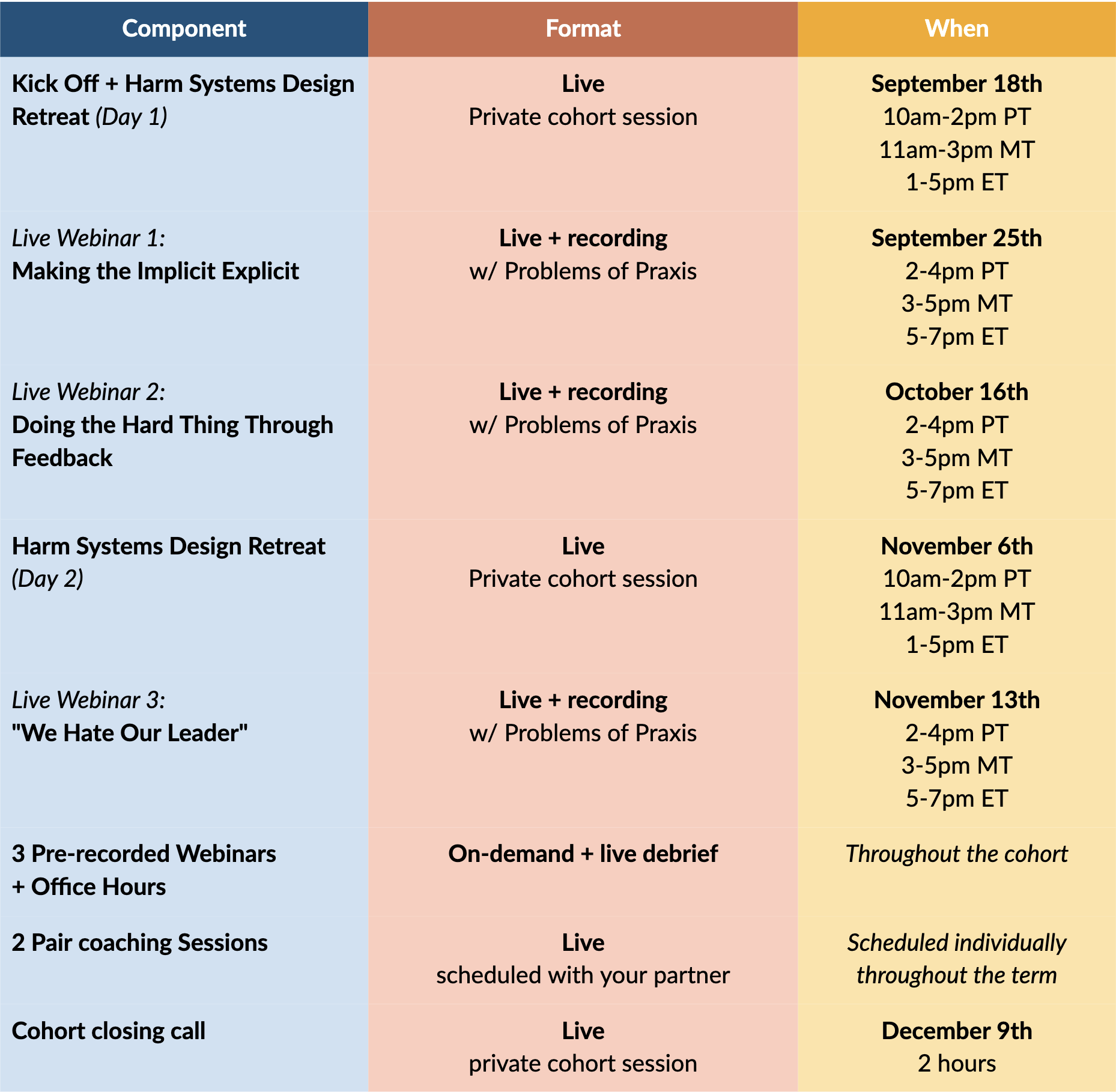
A three-month cohort experience running September through December, combining live learning, private practice space with your team, and hands-on tools you can start applying right away.
Learning with (and from) your cohort
Our facilitators aren't the only ones you'll learn from. Each cohort brings together peers from other values-driven organizations working through their own versions of these same patterns, some similar to yours, some completely different. This will be a space for nonprofits, coops, grassroots collectives, and other formations to learn with and from each other.
That range is part of the design. Hearing how another organization navigated a founder transition, untangled a stalled feedback culture, or worked on closing the gap between their stated values and their internal practice sharpens your own thinking in ways a single-organization training can't. You'll be in a community of peer support, alongside your colleague. This helps break the sense of isolation and siloing so many of us feel in holding workplace conflict.
Three live webinars + Problems of Praxis
Each live webinar closes with a 30-minute Problems of Praxis integration session, where we work through anonymized, real-world scenarios together and apply what you just learned. Can't make it live? Every session is recorded, but the live practice segment is where the frameworks become muscle memory, so we encourage you to be there if you can.
September 25th
2-4 PT / 3-5pm MT / 5-7pm ET
The things that shape how your team feels (who gets to rest, who absorbs the slack, how and when someone can say no) are rarely written down. These norms live in what's assumed, not what's said. Here, we get concrete about codifying care in practice, not just policy.
We'll cover creative benefits people actually use, accessibility and neurodivergent-inclusive practices for daily work, and real time off that doesn't just relocate burnout onto someone else's plate. We'll also talk through budget gaps and restructuring through a lens of shared power, and share two tools you can start using this week: a "How to Work With Me" guide, and a practice for saying "no, but here's what could help" as a group, before you're in crisis mode.
Everything here is pressure-tested. It's pulled directly from how Spring Up Cooperative runs itself and from tools workshopped with dozens of organizations.
October 16th
2-4 PT / 3-5pm MT / 5-7pm ET
Most of us were never taught how to give feedback well, so we avoid it, soften it into meaninglessness, or wield it like a weapon. In horizontal or shared-power structures, who gives feedback to whom, and what actually makes it fair? This session moves past the false choice between rigid hierarchy and structureless chaos, and reframes feedback as a practice that builds trust instead of eroding it. You'll leave with:
- Feedback methods grounded in design thinking
- A participatory action research model for closing the loop from feedback to action
- A way to ground feedback in clear accountability
- Models of multidirectional and 360 evaluation
- Right-sized, escalating consequences instead of avoidance or overcorrection
- A healthier way to think about endings
November 13th
2-4 PT / 3-5pm MT / 5-7pm ET
Groups tend to seek and find someone to blame. When things go wrong, or even when they're just hard, leaders often become the screen onto which a whole team projects its frustration and unmet needs. This session takes an honest look at what happens beneath the surface of our relationships to authority. We'll cover:
- Power over, power under, and power with, and what shifts when hierarchy is fixed versus rotating
- Psychodynamic patterns like countertransference, projection, idealization and devaluation, splitting, and the golden shadow
- Hollow prize theory, and why leadership so often feels like a trap
- Racialized and gendered expectations placed on leaders
- Parentification and workplace-as-family dynamics
- Founder syndrome and the real health costs of over-accountability
Three pre-recorded webinars + office hours
Watch these on your own time, then join live office hours to debrief what's landing, what's hard, and how you're integrating the work.
How do we stay grounded in multiracial coalition building while doing abolitionist work that doesn't lean into deference politics, especially when identity politics gets weaponized to pull us apart instead of bring us together and build understanding?
How the invisibilization of feminized labor, like emotional labor, drives burnout, the economic patterns it's embedded in, and how it shows up specifically in mission-driven workplaces. We'll build boundaries and strategies to shift these patterns individually and organizationally.
How do we adapt our plans and expectations as capacity shifts over time? Like a flock of birds moving together through changing conditions, we'll learn tangible tools for tracking and responding to capacity, grounded in disability justice, consent, and design thinking.
Harm Systems Design: Non-Punitive Approaches from Organizing to HR
How an organization responds to harm is its accountability in action.
Our most popular retreat for workplaces, delivered as two live private half-day sessions for your cohort.
Day 1: September 18, 10am-2pm PT / 1-5pm ET Day 1 puts harm response in context: how we approach onboarding, shared language, culture, conflict, and feedback, and what norms your harm response protocol needs to fit within.
Day 2: November 6, 10am-2pm PT / 1-5pm ET Day 2 prioritizes prototyping: a step-by-step process for responding to harm, guided by our 5-step framework with core tools aligned to each step.
You'll leave with a tangible prototype for how your organization responds to harm, built for your actual context, not a generic template.
This retreat is designed with care. A few things to expect:
- Closed captions throughout, with text on slides read aloud
- Encouragement to take care of yourself and those around you: move as you like including standing, sitting, laying down, stimming, turning your camera off, eating, or stepping out as needed
- Breakout prompts with the option to journal independently instead of talking
- Consistent breaks throughout
-
Optional somatic and embodied activities you can opt into or skip entirely

Pair coaching
Two coaching sessions for you and the colleague(s) you registered with, meeting with one of our coaches. Spring Up coaching is peer-based, non-hierarchical, and solution-focused. We recognize you as the expert in your own lived experience. It's strengths-based and geared toward helping you clarify goals and build communication and self-care skills you'll keep using after the cohort ends.
Cohort Closing Session
December 9th
We close as a full cohort to debrief the program together and map out how you'll bring what you've learned back to your team, with concrete next steps for implementing the tools and policy designs you've built.
Frequently Asked Questions
Can my organization pay for our registration?
Yes. Email us at bluelight.academy@timetospringup.org for an invoice for your group, or register individually and receive a receipt for reimbursement.
How does sliding-scale pricing work?
If you're a resourced, formal institution (a school, foundation, business, or nonprofit with a budget over $1M), we ask you to pay at the top of our sliding scale. That helps subsidize access for informal, community-based organizations and student groups at the lower end. Small and medium nonprofits, conferences, and advocacy groups fall in the middle. We'll follow your lead on what your organization has available for professional development.
Do we have to attend everything live?
The three live webinars (including the Problems of Praxis segment) are recorded, so you can catch up if you miss one. That said, the live practice and group discussion only happen in real time. The Harm Systems Design retreat days and pair coaching are live-only experiences.
What if I can't make one of the live retreat days?
We also run the same two-day Harm Systems Design retreat for the public on Friday, October 23 and Friday, October 30. If the cohort dates don't work for you, you can transfer your registration to one or both of those dates instead.
Does this work for folks outside the US?
All times are listed in PT, MT and ET, so check the schedule against your timezone before registering, since the retreat days and integration sessions require live attendance.
Is this only offered in English?
We can provide live Spanish and ASL interpretation with at least two weeks' notice.
Who else will be in the cohort?
Participants come from across the ecosystem of liberation work: nonprofits, education, grassroots organizing, therapy and social work, intentional communities, and philanthropy. There's no gatekeeping. If this feels like the right fit, you're welcome.
How long do we have access to the materials?
Forever. Access to the recordings, slides, and resources from this cohort doesn't expire.
Can more than 2 people from my organization join?
Absolutely! You can have up to 6 people from your organization join. If you want to have more than 6 people join, we would recommend doing a private training instead of joining the cohort program.
Rebuild trust: strengthen relationships, build skills, and design values driven systems.
*Registration requires at least two participants per organization or collective.
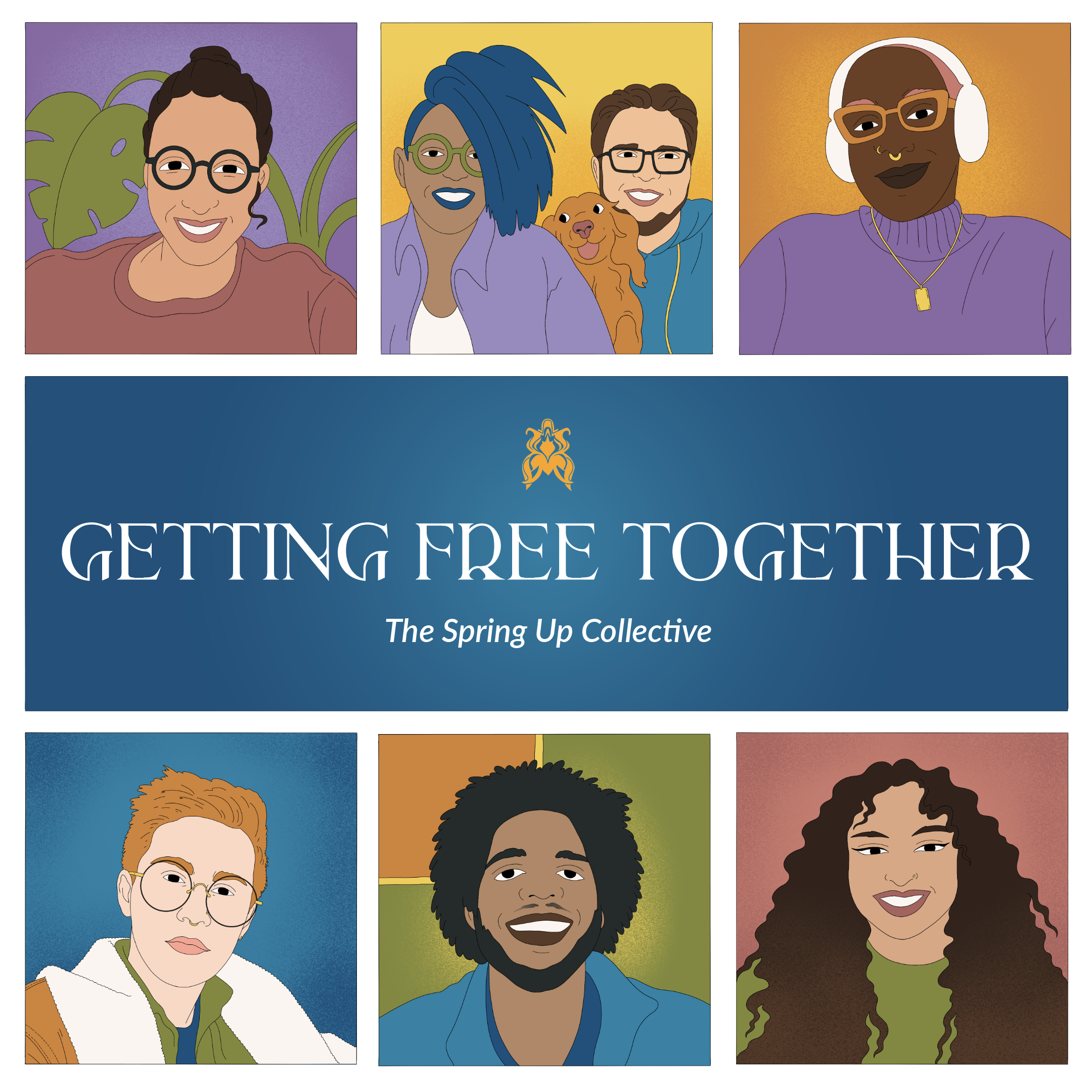
This cohort is facilitated by Spring Up
Spring Up is a Black and Queer-led a collective of seven care workers, transformative justice practitioners, liberatory educators, and coaches practicing and teaching the liberatory arts here at bluelight academy.
We operate as worker-cooperative rooted in the values of consent, accountability, and transformation. For over 10 years, Spring Up has used fiction, art, role play, and community education to popularize the skills and frameworks necessary to be free together.